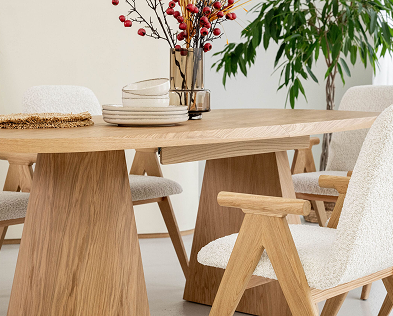
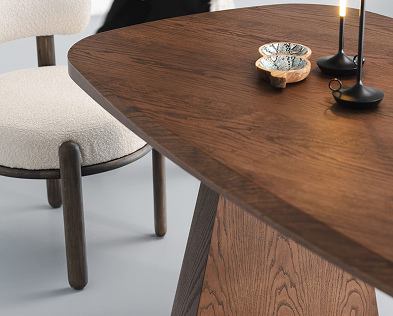
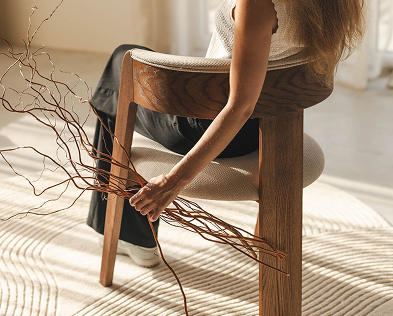
Japandi is an interior style that combines Japanese serenity with Scandinavian simplicity. The name is a blend of Japan and Scandi, and the style revolves around balance, functionality, and conscious choices. A Japandi interior feels calm and organized, but never cold. Natural materials, understated colors, and thoughtfully designed furniture create a living environment that brings peace and remains pleasant for years to come.
What distinguishes Japandi from other minimalist styles is the combination of two different types of “less.” Japanese minimalism is understated and almost meditative. Scandinavian minimalism is light, practical, and cozy. Together, they deliver an interior that is both serene and comfortable. Not a showroom, but a place to live.
What does Japandi mean?
Japandi is a portmanteau of Japan and Scandi, the abbreviation for Scandinavia. The word indicates a fusion of two living cultures that are geographically far apart but have much in common in terms of content: minimalism, functionality, and respect for natural materials.
The style is often described as “the best of both worlds.” Japan brings refinement, restraint, and the philosophy of wabi-sabi: the appreciation of imperfection, transience, and simplicity. Scandinavia brings warmth, comfort, and the hygge lifestyle: a sense of security, peace, and small daily joys. Where wabi-sabi finds beauty in a crack or asymmetry, hygge adds the soft rug and warm light.
These two philosophies complement each other instead of clashing. Wabi-sabi prevents a Scandinavian interior from becoming too polished, and hygge prevents a Japanese interior from feeling too austere. The result is a style where everything feels right, but nothing has to be perfect.
Where does the Japandi style come from?
The term Japandi is relatively new, but the interaction between Japanese and Scandinavian design goes back more than 150 years.
The foundation lies in the 19th century, shortly after Japan reopened its borders to the West after more than two centuries of isolation. Danish naval officer William Carstensen traveled to Tokyo and published the book Japans Hovedstad og Japaneserne (“The Capital of Japan and the Japanese”) in 1863, which had a major impact in Denmark and sparked interest in Japanese aesthetics. Official diplomatic relations between Japan and Denmark were established in 1867, and since then, Danish designers, architects, and artisans have been inspired by Japanese craftsmanship and minimalism.
What Danish designers recognized in Japan was not an exotic opposite, but a kindred way of thinking. Both cultures value honest materials, careful craftsmanship, and the belief that a well-designed object should last for decades. Those shared values formed the basis for what would later be called Japandi.
In the 20th century, that influence became visible in concrete furniture designs. The encounter with Japanese art provided Danish craftsmanship with new impulses and was an important prerequisite for the modernism that made Denmark a design nation, as documented by Design Museum Denmark in the exhibition Learning from Japan. Danish furniture makers learned from the Japanese attention to joints, wood, and proportion. Japanese designers, in turn, were inspired by the Scandinavian focus on comfort and coziness.
The term Japandi itself came into vogue around 2016 and became a real trend from 2020 onwards, partly due to the need for peace and space during the pandemic. As people spent more time in their own homes, the need grew for an interior that doesn’t scream for attention, but rather brings tranquility. Its popularity has continued to grow ever since.
What are the characteristics of the Japandi style?
Japandi is not a collection of loose elements, but a cohesive style. These six characteristics together form the foundation.
1. Minimalism with warmth. Only what is necessary, but never bare or sterile. Textiles, plants, and soft lighting provide a homely feel. This is the difference between Japandi and pure modernist minimalism: a Japandi space can be tidy, but it must always feel inviting.
2. Natural materials. Wood, linen, wool, ceramics, and stone form the foundation. They are preferably used in their pure form, with matte finishes and visible texture. High-gloss, chrome, and plastic do not fit within the style. You can read about which materials work best in our blog Which materials suit Japandi?.
3. Low, functional furniture. Clean lines combined with subtle organic shapes. Slender legs instead of massive builds, low seating elements that visually enlarge the space, and cabinets that offer storage without being dominant. View our collection of Japandi furniture for specific examples.
4. Calm, neutral color palette. Beige, sand, cream, and light gray as a base, complemented by earth tones like taupe and olive green, and sparse dark accents in black or walnut. No bright colors or busy patterns. Depth is created by combining different shades within the same color family.
5. Craftsmanship over decoration. Every object has a function or a story. Better one well-chosen handmade vase than five small mass-produced items. This choice for ‘less but better’ is not just an aesthetic matter. It is also practical and sustainable, as high-quality materials last longer.
6. Imperfection as a quality. Inspired by wabi-sabi: a handmade bowl, visible wood grain, or slight asymmetry is seen as character, not a flaw. An industrially perfect space feels cold within the Japandi style. It is the small irregularities, such as a knot in the wood or an uneven glaze, that make an interior feel human.
Why does Japandi work so well?
Japandi appeals to people for the same reason the style originated: it meets a growing need for peace in a busy world. A Japandi interior is not a collection of loose trends, but a cohesive response to overstimulation, fast consumption, and throwaway culture.
The style works on three levels at once. Visually, it provides peace: fewer colors, fewer objects, more space. Practically, it is functional: everything is there for a reason, storage is thoughtful, and spaces remain easy to keep organized. Emotionally, it feels timeless: because the style does not lean on fads, a Japandi interior will still feel right ten years from now.
Additionally, Japandi is forgiving. You don’t have to replace everything at once. A few conscious choices (a wooden dining table, linen curtains, an honest vase) already shift an interior towards Japandi without the whole house needing a complete overhaul.
Is Japandi timeless or a trend?
Japandi has the characteristics of a trend (rapidly growing popularity) as well as a timeless style. The basic principles, such as quality, simplicity, functionality, and respect for materials, have existed for centuries and do not go out of style. What can become dated are extreme variations or trendy accessories. We go into more detail on this in our blog Is Japandi timeless or is it a trend?.
Japandi at a glance
| Element |
Characteristic |
| Origin |
Fusion of Japanese and Scandinavian design, foundation since 1863 (Carstensen’s book), term since around 2016 |
| Philosophy |
Wabi-sabi (imperfection) + hygge (coziness) |
| Colors |
Beige, sand, cream, taupe, light gray + dark accents |
| Materials |
Wood (oak, walnut), linen, wool, ceramics, stone |
| Furniture |
Low, functional, slim legs, organic details |
| Atmosphere |
Calm, refined, warm, timeless |
| Best for |
Those who want less but better, and love peace and quality |
Japandi is an interior style that brings together Japanese philosophy and Scandinavian pragmatism. By centering on peace, simplicity, and natural materials, it creates an interior that is not only beautiful but also logical and pleasant to live in. No excess, no seasonal trends, just conscious choices that stand the test of time.
Looking for furniture that truly fits this style? View our collection of Japandi furniture and Japandi dining chairs, featuring hand-picked pieces in oak, walnut, and natural fabrics.